PRIVATE SECURITY: THE CRITICAL MINERALS GAME-CHANGER POLICYMAKERS AND INVESTORS CAN’T AFFORD TO IGNORE

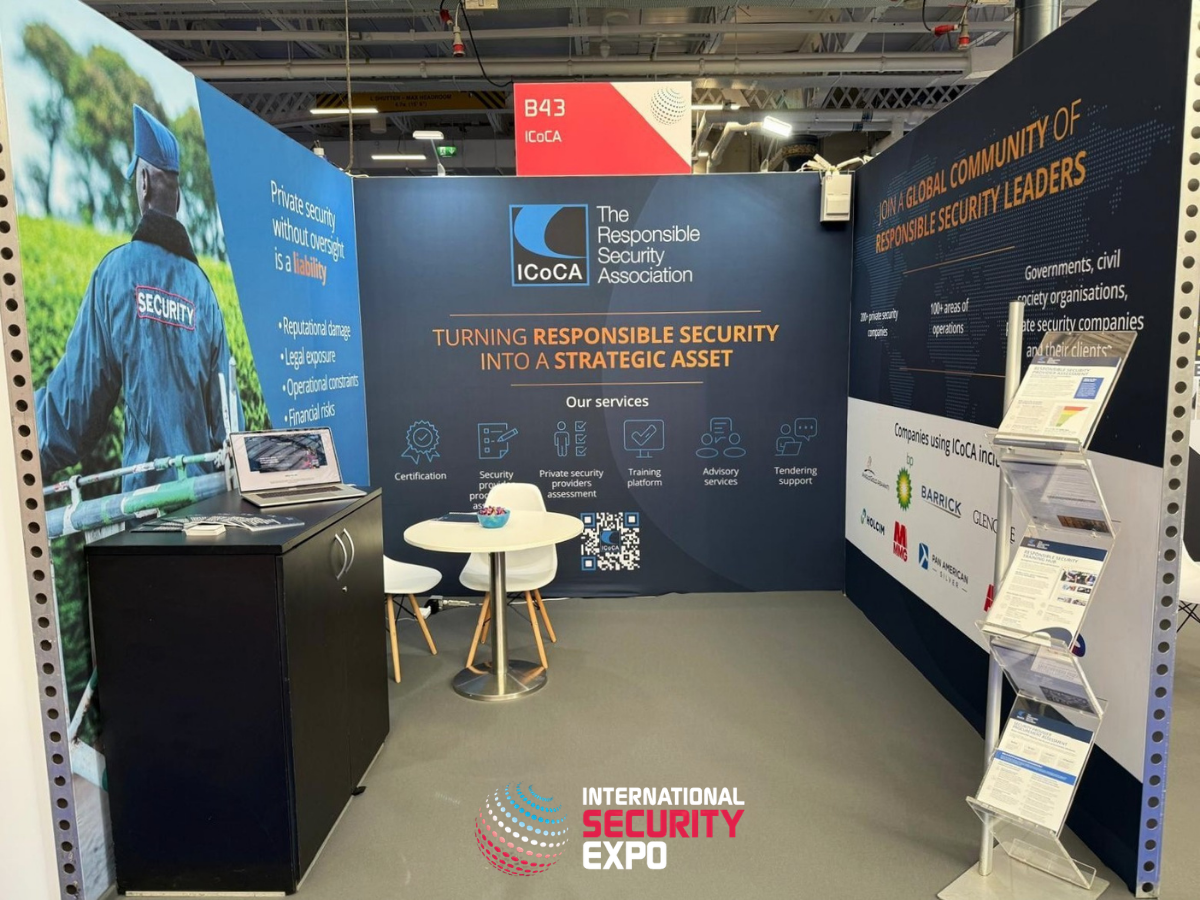
Alongside exhibiting at the International Security Expo 2026, held in London, ICoCA Executive Director Jamie Williamson spoke at its International Security & Resilience Conference. Addressing a mixed audience of security experts and providers, diplomats, public officials and consultants, his speech focused on the role and opportunities of the private security sector in the critical minerals race.

The central point: with governments signing critical minerals deals at a pace not seen in a generation and private capital following closely behind, private security can no longer be relegated to a downstream operational afterthought.  It is a strategic lever that will help determine whether critical minerals strategies and investments deliver, or derail.

A summary of his speech follows.


The race is on

Over the last couple of years, the race for critical and rare earth minerals has become central to economic security, industrial policy and defence planning for Western States, the G7 and countries across Latin America. The many national critical mineral strategies are increasingly translating into agreements, deals and projects on the ground.

By way of example, the EU and Rwanda signed a partnership on sustainable raw materials value chains in 2024. In 2025 came the United States–Ukraine Reconstruction Investment Fund and the US–DRC Strategic Partnership Agreement. At the 2026 Critical Minerals Ministerial in Washington, the United States concluded memoranda and frameworks with more than 21 countries, from Argentina, Peru and Ecuador to Guinea, Morocco, the Philippines, the UAE, the UK and Uzbekistan, and completed negotiations with seventeen more. Kazakhstan and the United Kingdom are deepening cooperation on processing and logistics. And in September alone, the United States announced three new initiatives targeting critical minerals in Nigeria, the DRC and Zambia, and launched the Andes-Atlantic Corridor with Argentina to modernise infrastructure linking its mineral-rich northwest to the coast.

In addition to government deals, private capital is jumping on the critical minerals’ bandwagon. For instance, an AI-driven exploration company backed by Bill Gates and Jeff Bezos is now valued at close to USD 3 billion as it positions itself against Chinese competitors. Glencore has signed an MoU with the Orion Critical Mineral Consortium on the potential sale of a 40% stake in two of its major copper and cobalt operations in the DRC: Mutanda Mining and Kamoto Copper Company. New funds are also forming quickly.


A spectrum of risks

Headlines over recent months offer a stark reminder of the risks and of what is at stake. In Peru, the bodies of thirteen workers kidnapped at a major gold mine were found a week after their abduction, amid a surge in illegal mining and criminal violence. In the DRC, gunfire from soldiers at an artisanal mine site triggered a stampede across a bridge that collapsed under the weight of fleeing diggers, leaving dozens dead and injured. In Ethiopia, KEFI Gold and Copper suspended development at its Tulu Kapi project after a serious security incident in which security personnel, community members and a company employee were killed. And a recent study by the Business & Human Rights Resource Centre’s 2026 Transition Minerals Tracker found that allegations of human rights abuses at major tracked mining operations rose by 73% in 2025, amid growing competition to secure transition minerals.

These should not be read as isolated events. Critical minerals projects face a spectrum of interlocking risks: geopolitical competition, including the growing presence of foreign military actors, organised crime and banditry, maritime threats along the routes that carry most of the trade, tensions with local communities, corruption and collusion, and the legal, reputational and financial consequences that follow when things go wrong.


A growth market for private security

With risk comes demand for more security investment and services. By way of example, take the Lobito Corridor Project, a 1,300 km route linking the DRC, Zambia and Angola, backed by nearly USD 6 billion in public and private finance and seen by the United States and G7 as a key route to critical minerals. Conservative estimates put security-related spending over its construction and operational life at USD 100–250 million. That is a significant opportunity for private security providers and potentially a major source of security-related employment in the region.

The DRC, it has been reported, plans to deploy up to 20,000 specialised mining guards nationwide by 2028, starting with an initial USD 100 million investment to recruit up to 3,000 armed personnel by December 2026. The aim is a dedicated structure protecting mineral production and supply chains against illegal mining and insecurity.

Whether these forces are public or private, the scale is striking. But with such an increase in investment in security across the critical minerals sector, important questions arise: who sets the standards for how these forces operate, and who holds them to account?


Guardrails needed

Governments and international organisations seem to have recognised the need for guardrails and responsible business practices. Addressing the UN Security Council in July, the European Union stressed that critical raw materials should be drivers of prosperity and not sources of conflict, human rights violations and other abuses. It called for better application of existing international frameworks and support for responsible business conduct.

Across Western capitals, the same message has been echoed. The UK has committed to responsible business conduct and to influencing governments and businesses to lower the risk of violence, conflict and human rights abuses in the extractives sector. G7 governments have pledged to promote responsible mining practices and build the capacity of mineral-rich partner countries. Canada goes further still, framing responsible business practice as a competitive advantage that sets its companies apart in global markets.

The EU Critical Raw Materials Act turns responsible business conduct into a condition. Strategic projects must show they will prevent and minimise adverse social impacts through socially responsible practices, including respect for human rights, Indigenous peoples and labour rights, meaningful engagement with local communities, and transparent business practices that guard against corruption.

The commitments are on paper and in high level commitments. The test is implementation, and at a mine site or along a transport corridor, this will have to include the conduct of the people providing security.


Time to step up

Responsible private security is the lynchpin of responsible business conduct in critical minerals. The choice is stark: high losses, abuses and litigation, or upfront investment in due diligence and risk mitigation. Done right, responsible private security:

  • Mitigates downside financial risk and operational disruption
  • Secures the social licence to operate
  • Fulfils fiduciary and regulatory human rights due diligence (HRDD) and environmental, social and governance (ESG) requirements
  • Protects corporate and brand reputation

Policymakers, investors and asset owners must step up their game. Clients drive standards up or down depending on whether they buy security on cost alone, and the industry has too often seen a race to the bottom.

ICoCA, with members and partners spanning governments, civil society, security providers and major multinationals, offers a practical route from commitment to verifiable practice. We stand ready to help ensure that the race for critical minerals is a vector for good and not a recipe for disaster.