
Certification
ICoCA certification represents ICoCA’s highest level of independently verified assurance for private security providers.
How does it work?
Combining independent certification to a recognised standard with ICoCA’s own assessment, due diligence, monitoring, reporting and accountability mechanisms, ICoCA certification provides clients with the maximum assurance their security provider is operating responsibly.
To become ICoCA certified, a private security provider must first be certified by an ICoCA-accepted certification body against one of the following standards:
| Standard | Scope |
|---|---|
| ISO 18788 | Management system for private security operations |
| PSC.1 | Management systems for quality of private security company operations |
| ISO 28007 / ISO 28007-1 | Guidelines for private maritime security companies (PMSC) providing privately contracted armed security personnel (PCASP) on board ships |
Security operations take place in complex environments where risks evolve and relationships with communities matter. Human rights can be affected directly by decisions made on the ground. ICoCA’s ongoing oversight including through monitoring, reporting, complaints and remediation mechanisms, provides assurance that responsible security commitments are implemented in practice.
Involving civil society in this process, certification is not a one-time compliance exercise, but part of an ongoing accountability framework.
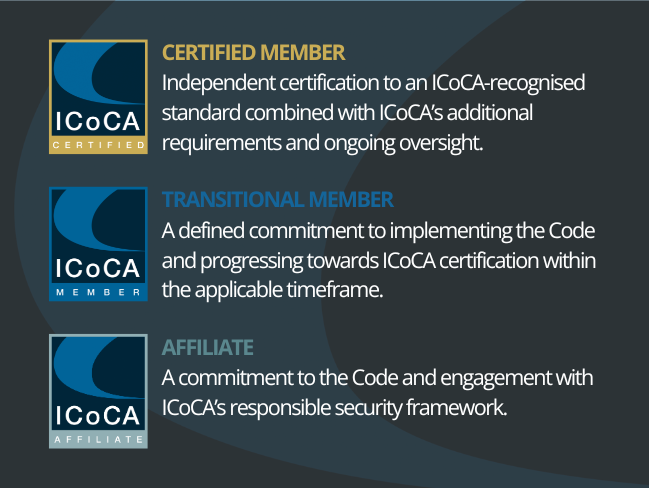
ICoCA categories: a progressive assurance framework
ICoCA provides different pathways for private security providers to demonstrate their commitment to responsible security, recognising that companies may be at different stages in their journey towards implementing the Code and strengthening their systems and practices.
Affiliation and transitional membership provide meaningful pathways for providers to demonstrate commitment to responsible security, while certification adds independent third-party verification of the provider’s implementation of the Code.


Why does this matter to clients?
For organisations contracting private security providers, ICoCA affiliation and membership can form an important part of human rights and responsible business due diligence.
ICoCA provides clients with a practical framework against which providers are assessed, that mitigates the operational, legal, financial and reputational risks associated with private security. This includes:
- independent certification against an ICoCA-recognised standard (certified members);
- ICoCA assessment and ongoing monitoring;
- regular reporting and self-assessment;
- a complaints and remediation mechanism; and
- training, guidance and continual improvement.
For clients across all sectors, this provides greater confidence that their security providers are operating responsibly and that commitments to the Code are supported by ongoing oversight and accountability. It can support more informed procurement and due diligence and demonstrate alignment with best practice.
Turning responsible security into a strategic asset
Responsible security is about more than managing risk. It can help organisations demonstrate their commitment to human rights, strengthen their social licence to operate and build trust with the people and communities affected by security operations.
By driving up standards in private security and strengthening accountability, ICoCA helps clients across all sectors approach security not simply as an operational liability, but as a strategic asset supporting responsible business, resilience and long-term success.

Join a growing group of multinational companies
A growing group of companies have joined ICoCA as observers to improve due diligence on their security supply chain. Using ICoCA certified security providers assists multinationals with their human rights due diligence obligations under new laws such as the EU Corporate Sustainability Due Diligence Directive (CSDDD) and helps meet increasing investor expectations to demonstrate effective human rights due diligence on private security supply chains.